

Versione italiana disponibile qui → [IT]
Author’s note
This is not Chapter 6 of Legacy Things.
I know I am stepping off the usual path, but in Italy August is a different kind of month. IT infrastructures keep doing their job, tickets keep coming in, and with rare exceptions servers do not go on holiday. Many of the people who manage them do. And, quite rightly, so will the person writing this.
I did not want to interrupt the series. So I asked myself what would be worth publishing in a month when many IT admins already have their heads somewhere near the beach.
This month I decided to do something different: a special episode outside the regular numbering, a small summer detour from the main path of the series. A fictional story, openly fictional, but built around technical behaviours that are plausible, real and verifiable by anyone who works with legacy systems.
A kind of nerdy beach read 😊
The idea is simple: this first part tells an IT case to investigate and leaves the enigma open. The second part will arrive later with the full technical solution.
I would like to invite readers to form a hypothesis and write it in the comments. You do not need to guess everything. Sometimes it is enough to look in the right place.
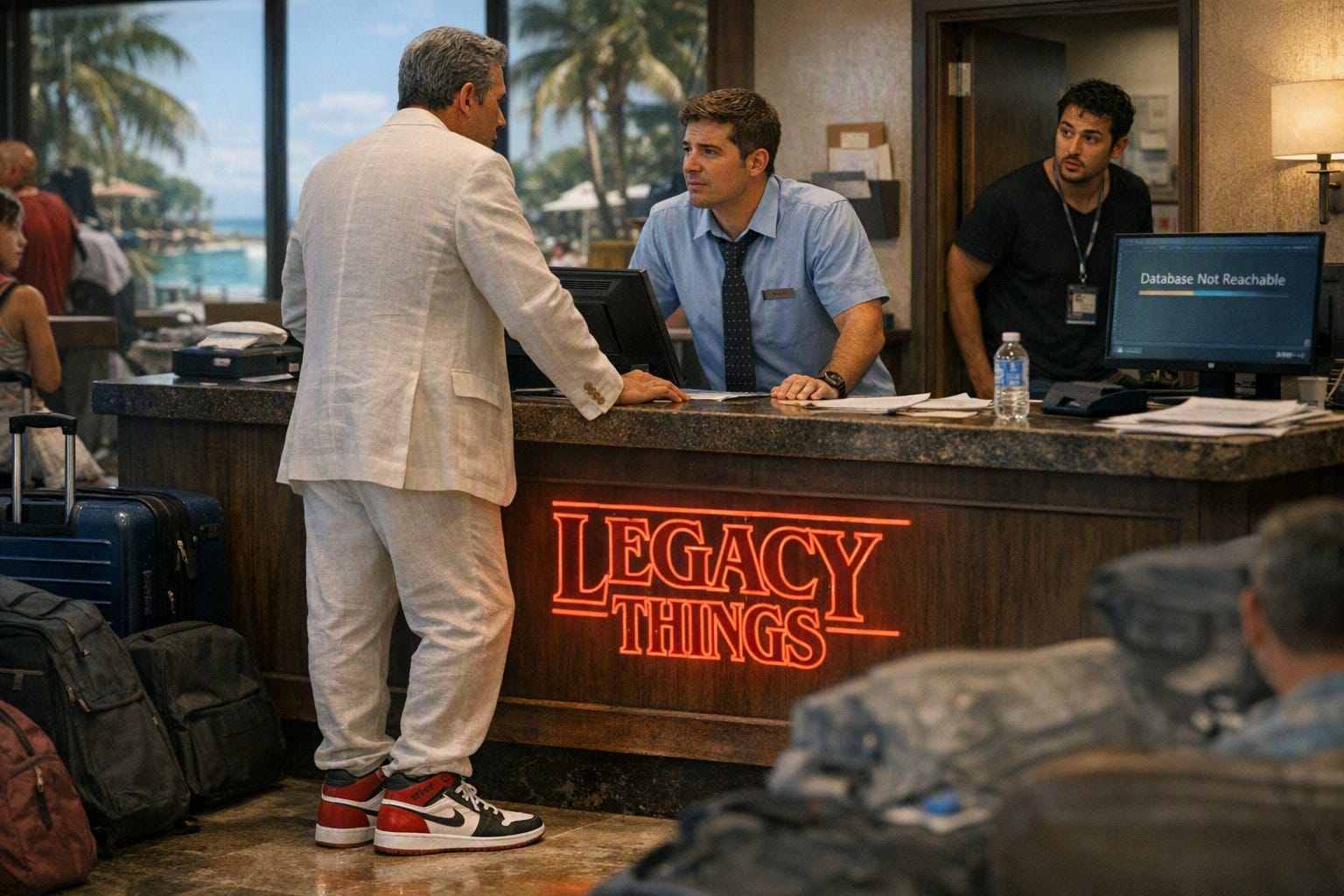
On July 27, 2026, the door of a bus opened and a seemingly distinguished gentleman stepped down, although on closer inspection there was something unusual about him. Perhaps the Nike Air Jordans worn under a linen suit were not the safest style choice, but he carried them with remarkable ease.
Sid Historia had lived in London long enough to complain about the rain like an Englishman. But he still had enough Argentine roots left not to remain composed when a situation got out of hand. In those moments, he usually swore in a colourful way.
That day he was finally reaching the destination of his holiday. After months in which the sun had seen him only in small doses, he had chosen to spend a week in a beautiful resort on a Caribbean island. Just him, his suitcase and a small paradise to discover.
Relax, sea, breeze, at most a good book. He did not want to touch a keyboard or a mouse for the entire stay. Even his smartphone would remain in the room during the day.
He needed to detox from his world, made of complex IT systems that often rebelled against what customers expected from them. He was a consultant, a good one, with many years of experience behind him. The kind of person you call when you no longer know where to look.
But there was one thing he had not planned for: the storm had arrived the night before.
One of those brief and furious summer storms, able to turn a postcard coastline into an end of the world scene in just a few minutes. Wind, horizontal rain, lightning over the sea and a blackout that had lasted a few hours, long enough to leave the whole property with a very unpleasant feeling.
When Sid reached the reception desk, he caught that feeling immediately. His left eyebrow rose like an antenna.
In front of him there was a small line of guests waiting, scattered trolleys, children jumping on sofas with the leftover energy of those who had already finished watching cartoons on a tablet, and adults beginning to lose patience.
Behind the counter, the staff were smiling. But it looked less like a smile and more like an advertisement for whitening toothpaste. It was clearly fake.
His antenna picked up something else. The monitor in front of the receptionist showed a white screen with an error window in the middle.
Database not reachable.
Three simple words, but he had already guessed the scale of the situation.
Sid read the message, looked at the queue, then looked at the receptionist asking for his name with a tired voice.
At that point he exclaimed: “Holy Token, qué desastre!”
He should not have said it out loud. But it was part of who he was and he never really tried to hide it. It was the expression that came out when things were out of control. Sometimes it had even ended up in articles he had published.
From a side door appeared a young man with a worn badge and the dark circles of someone who had slept very little. On the badge, written in blue letters, Sid managed to read a name: Mateo.
Mateo stopped. He looked at him more carefully.
“Wait a second… are you Sid Historia?”
Sid looked up at the ceiling with the expression consultants make when they are recognised outside their natural habitat. A strong desire to vanish instantly was making its way through him.
“That depends on what happened,” Sid replied.
The young man gave a faint smile, as if that were confirmation enough.
“I read your articles all the time. The ones about old IT things that seem absurd until you discover why they exist.”
Sid lowered his eyes toward the monitor and asked, “Is this absurd enough?”
“For twelve hours,” Mateo replied.
Sid took half a step back. The instinct to run was emerging. He had just arrived. He had promised himself a week without touching other people’s systems, without improvised meetings, without sentences like “it has always worked”.
“I am sorry, really. But I am on holiday…”
The young man nodded and the smile disappeared. He did not look surprised. He looked like someone who had expected that answer before even asking the question.
“I know. But if you could just take a quick look…?”
At that point Mateo turned toward the reception desk, then toward the small crowd waiting. He reached the manager, who until then had been watching the scene from a distance, and they exchanged a few words in a low voice.
The manager approached very carefully, the way one approaches wild animals or senior consultants outside office hours.
“Mr Historia, we do not want to ruin your holiday. But if you could help us understand where to look, we could upgrade you to the panoramic suite. The best one in the property. Sea view, private terrace, spa access. For the entire stay.”
Sid remained silent.
The rational part of his mind reminded him it was a trap. The tired part reminded him he had booked a standard room with a parking lot view. The worst part, the one he always tried to keep under control, had already started wondering why a “database not reachable” error was blocking an entire resort.
“Just a quick look,” Sid said.
Mateo smiled for the first time with something that looked like hope.
“Just a quick look,” Mateo repeated.
Sid knew that sentence, in IT, was one of the oldest lies in the profession. But by then he had already accepted and could not back out.
Mateo was the IT manager of the resort, a title that at that moment mainly meant being the person with a target painted on his back.
He led Sid into a small office behind reception. On the table there were an open laptop, two phones, an empty energy drink and the universal expression of overnight troubleshooting: notes written in a hurry, crossed out, rewritten and smudged.
“Strong storm last night. Blackout. When power came back, everything seemed fine. Then the booking system stopped opening reservations. Since then we have had this error,” Mateo explained.
“Database not reachable,” Mateo added, pointing at the monitor.
“I had already noticed,” Sid replied.
The first hypothesis was so natural that it already sounded like a rushed diagnosis: during the storm some network device had failed, or storage had broken a transaction, or a server had suffered corruption. Mateo and his colleagues had checked switches, firewalls, links to the outside, the virtual machine running the booking system, snapshots, services and restarts.
Everything seemed to point at the storm, but the checks on the ground seemed to clear it. Sid’s sixth sense told him not to trust the storm.
“Has the database been checked?” Sid asked.
Mateo turned the laptop toward him.
“Locally, yes. From the application server too. The port is open, the connection starts. If I use the old admin tool, I can see the tables.”
“So the local database is not exactly dead,” Sid said, looking at a console that seemed to come from another era of IT.
“No. But when the local component tries to talk to the central database, the booking system still shows the same error.”
Sid narrowed his eyes and nodded. Old booking systems had an almost poetic ability to use a single error message to describe ten different problems.
“The application service?”
“It starts. It does not crash. If we work on local functions, such as internal records or the room list, it looks alive. But when the local component needs to retrieve booking data from BIGDB, the chain’s central database, it stops.”
“Data from the chain?” Sid asked, surprised.
Mateo opened a badly drawn diagram, but it was enough to tell the story. It looked like a child’s drawing, and with that in front of him he began to explain.
The resort was part of a larger hotel chain. Headquarters had a central Active Directory domain. The resort, acquired a few years earlier, still kept its own separate local domain, with several systems that had been born long before the acquisition. Between the two worlds there was a cross forest trust, created in a hurry one month after the acquisition.
“Does the trust work?” Sid asked.
Mateo made the face of someone who had already answered that question too many times. He opened the Active Directory Domains and Trusts console.
“According to the standard tools, yes. The relationship is there, I do not see obvious errors. If I ping an FQDN in the central domain, the name resolves and answers correctly. The IT colleagues from the chain also tell me that, from their side, they can see our systems. But the booking system keeps dying when it needs to talk to the central services.”
Sid leaned back in the chair. At first he still looked like someone doing a favour against his will. Then, almost without noticing, he began to lean toward the screen. The case had stopped being a holiday nuisance and had become a small enigma. And Sid had always had terrible self control when faced with enigmas.
That was when he stopped thinking he could get away quickly. In fact, it was exactly the kind of situation that intrigued him: the one where everyone sees something, but nobody sees the connection behind it.
“Out of curiosity, is only the booking system that old, or is there more?” Sid asked.
“Well… all the systems here are at least fifteen years old. But the Domain Controllers are Windows Server 2012 R2!” Mateo replied, with the air of someone hoping that was good news.
Sid thought of the old mantra “if it works, do not touch it,” but limited himself to asking: “Show me the application logs.”
Mateo opened a file with dozens of repeated lines. Most of it was noise, all the same. Attempts, timeouts, retries, secondary errors generated by the main error.
Sid read in silence. Then he pointed to a few nearly consecutive lines.
Opening booking session...
Local context initialized.
Central session validation failed.
Unable to establish secure session with BIGDB.hugechain.local.
Database unreachable.
“Interesting sequence of events,” Sid said.
“Why?” Mateo asked, moving closer to the screen.
“Because it says database unreachable after failing the secure session with the central services. Not before,” Sid replied.
The silence that followed was brief, but enough. Every technician knows that moment. The one in which an error begins to mean something.
Sid asked Mateo to repeat a simple test. Start the booking system. Log in with a local resort user. Open a function that stayed inside the local domain. Everything worked. Then open the reservations synchronized from headquarters. Waiting. Spinner. Error.
Database not reachable.
Same message. But now it was telling a different story.
“So the problem is not here?” Mateo asked.
“Maybe not,” Sid replied.
“It is not the database!” Mateo insisted.
“I would not acquit it yet. But the test we just ran says it is not the first suspect,” Sid clarified.
“The network?” Mateo asked.
“The network is always the first suspect. But we have already seen that the central systems respond,” Sid replied.
Mateo let out a tired laugh.
“So what do we look at?”
Sid went back to the diagram. Local domain. Central domain. Cross forest trust. Old booking system. Acquired resort. Central services. Local database alive. The moment BIGDB entered the picture, everything stopped.
“Let us look more carefully at the perimeter,” Sid said.
“The firewall?” Mateo asked.
“Yes, but not only. There are different kinds of perimeter,” Sid said.
That was the moment Sid Historia’s holiday was officially suspended. His mind was now immersed in a badly drawn diagram and in an error message too superficial to be taken literally.
The storm was still there, bulky, convenient, perfect to take the blame. It could have explained a corrupted disk, a frozen switch, a virtual machine that had not come back properly. It did not explain why the booking system worked as long as it stayed at home and died miserably the moment it had to ask something of headquarters.
The two worlds seemed healthy when taken separately.
The resort’s local domain answered. The central domain was reachable. The trust existed. The local database was not dead. The application service was not stopped. BIGDB, at least from the outside, seemed reachable.
And yet, the moment the perimeter was crossed, something stopped working the way it always had.
Sid looked at Mateo.
“Before we touch anything else, I want to understand one thing: do we know if anything changed on the other side?”
Mateo remained still for a few seconds.
“The other side?” Mateo asked.
“Headquarters,” Sid replied.
Sid leaned over the badly drawn diagram, Mateo’s pen still in his hand.
“If the problem is not here, and it is not there either...” he began, drawing a line between the two domains.
He did not have time to finish the sentence. The office door burst open. The manager, his shirt marked with sweat, did not even look at Sid.
“Mateo, the guest WiFi is still down. After the blackout, something did not come back up the way it should, and nobody can reconnect. I have three families in the lobby threatening to write terrible reviews.”
Mateo closed his eyes for a second, as if he were adding up how many things could go wrong in a single night.
“I’m coming,” he said, standing up.
Sid remained seated, the pen still suspended over the line he had just drawn. He watched the door close, then went back to staring at the diagram.
The blackout had left a real problem behind. It just was not the one that truly explained the enigma.
What now?
For now, the case remains open.
A resort that is only half isolated. A booking system accusing the database. A perfect storm. A cross forest trust that seems to exist. A local database that answers. And an error that appears only when the system has to cross the boundary toward BIGDB, the central database at headquarters.
The clues are few, but they are not random.
If you have worked with multi forest Active Directory, trusts and systems that have survived too many acquisitions, this is the moment to pause.
Where would you look?
The solution will arrive in Part 2.